

Mobile IV therapy during an airport layover depends on access, timing and booking. Learn what to verify before you schedule a treatment.
Last Updated: November 2, 2026
Quick Summary
Mobile IV therapy can be arranged during a layover, but a visiting nurse usually cannot reach your gate because, under Transportation Security Administration (TSA) rules, they would need to pass security like any other traveler. Appointments typically happen landside, such as in a nearby airport hotel or a public terminal area, so confirm the exact meeting location with the provider before booking.
- Airside areas past TSA security are closed to visiting nurses without a ticket or airport badge, per TSA’s airport security zone rules.
- Ask the provider for the exact meeting address and confirm it is landside.
- Confirm whether the hotel requires advance notice for outside visitors.
- Where a nurse may legally administer IV treatment is set by state nursing board regulations, so confirm the provider is licensed to treat you at the agreed location.
- Allow extra time beyond the treatment for setup, check-in, and travel back to your gate.
- Speak with a qualified healthcare professional first if you have a medical condition or take medications, consistent with FDA guidance on IV therapy safety.
Table of Contents
- What Mobile IV Therapy Involves for Travelers
- How Mobile IV Therapy Works in Practice
- Can a Mobile Provider Reach You at an Airport?
- Appointment Duration and How Much Time to Allow
- Booking Mobile IV Therapy at a Hotel Near the Airport
- Comparing Mobile IV Providers for Travel Use
- Questions to Ask Before Booking Your Layover Treatment
- Frequently Asked Questions
What Mobile IV Therapy Involves for Travelers
Mobile IV therapy brings a nurse and an IV hydration or vitamin treatment to wherever you are staying. For a traveler, that usually means a hotel room, a rental, or a private residence. Drip IV Therapy describes this kind of on-demand service, with treatments administered by registered nurses. State boards of nursing set the rules for where a visiting nurse may legally administer an IV treatment, so policies can vary by location (Source: National Council of State Boards of Nursing). (Source: TSA’s guidelines for medically necessary liquids)
The idea is simple. You request a visit, a nurse arrives, and a fluid and nutrient infusion is given through a small IV catheter in your arm.
Whether this fits your trip depends on your schedule, your location, and how much time you have. Time spent inside a secured checkpoint area is governed by the TSA’s own screening rules (Source: TSA security screening guidelines), which is part of what makes a layover visit tight. The rest of this guide looks at the practical question behind the keyword: can it actually be done during an airport layover?
How Mobile IV Therapy Works in Practice
A session generally starts with booking. Contact the provider to confirm how booking, location and timing are arranged. For recovery after a long flight, take a look at IVs for recovery.
Watch out: a common mistake is booking without confirming that the provider can reach your exact location. Hotel policies, building access, and staffing can all affect whether a visit goes ahead on schedule.
Medical suitability matters. Anyone with a medical condition, a history of reactions to IV treatments, or questions about medications should speak with a qualified healthcare professional before booking. Intravenous products carry risks that should be managed under medical supervision (Source: FDA).
Can a Mobile Provider Reach You at an Airport?
The honest answer is: rarely inside the secure area, often nearby. Understanding why requires knowing how airports are physically divided, because that division, not provider willingness, is what determines whether a nurse can reach you.
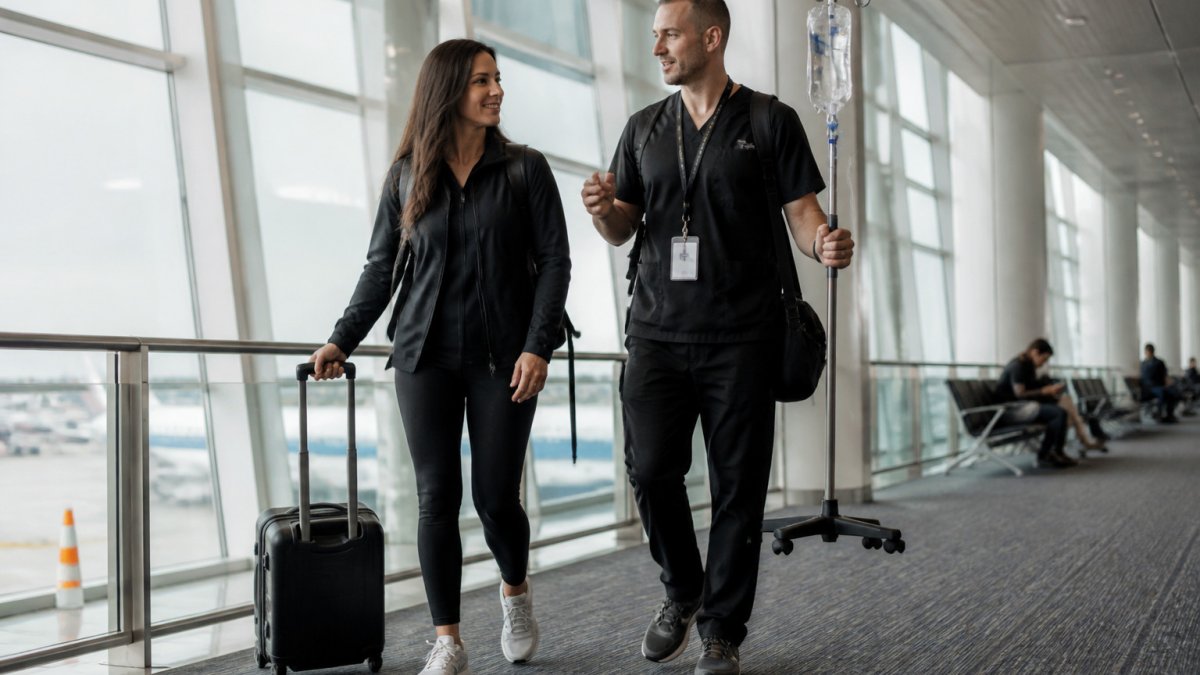
The Three Zones That Matter
Every commercial airport separates travelers into three practical zones:
- Landside (pre-security): Ticketing, baggage claim, rental car counters, and the public areas of the terminal. Anyone can walk in. A nurse with a treatment kit can generally meet you here without special clearance.
- Airside (post-security): Gate concourses, lounges, and shops beyond the Transportation Security Administration (TSA) checkpoint. Only ticketed passengers and credentialed airport workers are permitted. A visiting nurse without a ticket or an airport-issued badge cannot pass through.
- Sterile and restricted areas: Customs and border protection halls, international transit corridors, and airline operations areas. Access is tightly controlled and effectively closed to outside clinicians.
That means a realistic airport-area appointment almost always happens landside, in a public seating area, a landside airport hotel, a rental car facility, or a nearby off-site location, not at your gate. This also matches how state boards of nursing define the settings where a visiting nurse is authorized to administer treatment, a scope-of-practice matter the National Council of State Boards of Nursing outlines at the state level.
What Security Screening Means for a Visiting Nurse
A nurse carrying an IV start kit, fluid bags, tubing, and a sharps container is not a typical carry-on traveler. Even if a provider were willing to buy a ticket to reach a concourse, TSA screening rules for medical liquids and sharps, plus airline cooperation, make that impractical for a one-off visit. Health authority guidance such as the CDC’s injection safety recommendations also assumes infusions happen in a controlled setting, not a gate concourse.
Do not assume ‘airport service’ means gate-side. Ask the provider to name the exact address or zone where the nurse will meet you, then confirm it is landside and reachable without re-clearing security. ::: Navigating these logistical hurdles is essential because the rules for taking vitamins through security often differ significantly from the policies governing professional medical infusions.
Where Treatment Can Actually Take Place
Practical options generally include the following:
Possible locations include a landside airport hotel or a public landside terminal area. Confirm with the provider which options it can serve.
Questions That Get a Real Answer
Ask the provider specifically:
- Will the nurse meet me landside or airside?
- What is the exact meeting address, and is it inside a secured zone?
- Does the hotel or facility require advance visitor clearance?
- If I am connecting and cannot exit and re-enter security in time, what is the cancellation policy?
If a provider cannot answer these clearly, confirm service at your location before relying on it for your trip.
Appointment Duration and How Much Time to Allow
Treatment time depends on the formula and your individual situation. Ask the provider for an estimated session length before booking, and then add time for arrival, check-in, and getting back to your gate or your next commitment.
Allow more time than the treatment itself. Setup, paperwork, and travel time to your location all add up, and a rushed session defeats the purpose of a recovery treatment. Headaches can make a tight connection worse, so it helps to know about IV treatments for headache relief.
Booking Mobile IV Therapy at a Hotel Near the Airport
Hotels are often a practical location for a traveler. Readers who want to see how on-demand mobile IV service works for hotel-based recovery can review that guide before booking. To arrange a visit, confirm the time with the provider and check whether the hotel requires advance notice for outside visitors. Drip IV Therapy describes mobile service to hotels, homes, and offices; contact the company to confirm coverage for your location.
Comparing Mobile IV Providers for Travel Use
Not every provider serves travelers the same way. You can review the mobile IV service details and treatment options offered for travel use. Compare them on the points that matter most for a trip:
|
Factor |
What to Check |
|---|---|
|
Service location |
Hotel, home, office, or airport |
|
Booking speed |
Same-day or advance scheduling |
|
Pricing |
Published starting price or quote |
|
Hours |
Availability during early or late travel times |
|
Fees |
Whether trip, facility, or exam fees apply |
Pricing depends on the treatment, the location and the timing. You can browse the full range of IV treatment options available to compare. For Drip IV Therapy’s current pricing or a quote, visit its website or contact the team directly.
Questions to Ask Before Booking Your Layover Treatment
Before you commit, ask the provider: you can also arrange a mobile IV visit by contacting the team to start the booking. Airport access for any of these questions should account for TSA screening rules, since security checkpoints and restricted areas vary by airport.
- Can you reach a passenger in a terminal, or only at a hotel or private location?
- How do you handle airport security and restricted areas?
- What happens if my flight is delayed or my connection changes?
- How long does a typical session take, including setup?
- What are your nurses’ qualifications?
- Do I need to book in advance, and how far ahead?
- What is the total cost, including any fees?
- Is it safe for me given my medical history and current medications?
If you have a medical condition, are pregnant, or take regular medications, speak with your doctor before booking any IV treatment. A visiting nurse’s authority to administer IV treatment outside a clinical setting is set by the state board of nursing where the service takes place, so it is worth confirming the nurse is licensed for that state. The FDA does not evaluate or approve mobile IV vitamin therapy for general wellness claims, so weigh marketing claims with the same caution you would for any unregulated wellness service. Asking these questions upfront helps you decide whether mobile IV therapy will work for your layover.
Frequently Asked Questions
Can a mobile IV provider meet you during an airport layover?
Some mobile IV companies advertise delivery to a traveler’s location, including airports, but the supplied research does not confirm airport or terminal access for any specific provider. Airport access rules, security screening and terminal policies vary, so the reader should verify with the provider before relying on a layover appointment. Ask whether the provider has served that exact airport, how it handles airside areas, and what happens if the flight is delayed. Pricing depends on the treatment, the location and the timing, so contact Drip IV Therapy directly for current pricing and availability.
How much time should you allow for mobile IV therapy during a layover?
Appointment length depends on the treatment selected and the provider’s setup, so exact durations should be confirmed when booking. Allow extra time beyond the treatment itself for arrival, check-in, setup and a short recovery period. Because a layover can be short, build a buffer for the provider’s arrival window and for any delays. Missing a connection is a real risk, so an appointment that leaves little margin before boarding is not a good fit for a tight connection.
Is mobile IV therapy available at hotels near an airport?
Mobile IV providers often serve hotel rooms, which makes a nearby hotel a practical option for travelers with a longer layover. Confirm that the provider serves the specific hotel and area before booking, since service areas vary. Ask whether the provider needs the hotel’s permission to enter and whether it can accommodate your check-in and departure schedule. Drip IV Therapy describes delivery to hotels, offices and homes; contact the company to confirm coverage for your location.
What should travelers ask before booking mobile IV therapy?
Ask whether the provider has served your airport or hotel, how long the appointment takes and how much arrival time to expect. Confirm the nurse’s qualifications and how treatments are screened for medical suitability. Ask what the current price includes and whether any add-ons change the cost. Review the provider’s cancellation and rescheduling policy, especially if your flight may change. Check current pricing and availability directly with Drip IV Therapy, since specific prices are not published in this guide.


