

Learn how to get hotel IV hydration delivered to your room in 7 steps. Compare what to expect, booking details, and safety checks before you book.
Last Updated: November 6, 2026
Quick Summary
Hotel IV hydration delivers fluids, electrolytes, and vitamins to your room by a licensed nurse, so you skip the clinic trip. Confirm your hotel allows in-room infusions, complete medical screening, and book a mobile nurse for your actual arrival window with a buffer.
- Call the front desk first to confirm a licensed provider can visit your room.
- Share your room number only after check-in with the key in hand.
- Ask where a service provider should park, since many hotels lack vendor parking.
- Arrange front desk buzz-up or a lobby meet for key-card elevators.
- Book at a flat, listed price — at Drip IV Therapy you see the full cost before you book.
Table of Contents
- Why Hotel IV Hydration Beats a Clinic Visit
- What to Expect During a Mobile IV Appointment
- Step 1: Confirm Your Hotel Allows In-Room Infusions
- Step 2: Complete Screening and Share Your Medical History
- Step 3: Book a Mobile IV Nurse Near Me for Your Arrival Window
- Step 4: Understand Pricing and What Drives Cost
- Step 5: Prepare Your Room and Yourself for the Visit
- The Benefits of IV Therapy for Jet Lag and Travel Recovery
- Frequently Asked Questions
Why Hotel IV Hydration Beats a Clinic Visit
Hotel IV hydration is a mobile service that brings fluids, electrolytes, and vitamins to your room, administered by a licensed nurse, instead of requiring you to travel to a clinic. The market for IV hydration therapy was estimated at USD 3.22 billion in 2026, according to Mordor Intelligence’s market analysis, and a big share of that growth comes from people who want treatment where they already are.
Here’s why the hotel-room version wins:
- No travel time. You avoid getting to and from a clinic.
- Convenience. The service comes to your home, hotel, or office.
- On-demand booking. You schedule around your day.
What to Expect During a Mobile IV Appointment
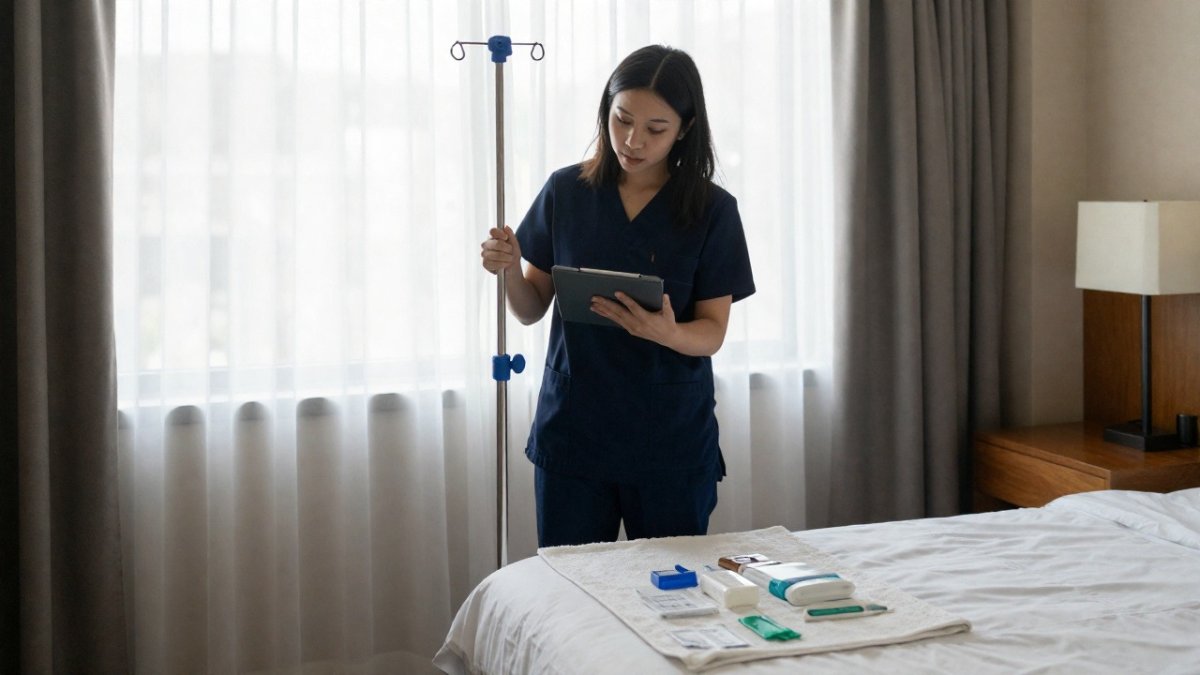
Your nurse arrives at the scheduled time and sets up in a small space by a chair or the bed. After confirming your screening answers and checking your vitals, the nurse places the IV — most people feel just a quick pinch — and the infusion runs about 30 to 60 minutes while you rest, work, or watch TV.
Afterward, the nurse removes the catheter, applies a bandage, and tells you what to watch for. You’re free to go back to your day. If you are wondering how long the fluids will last, see how long IV fluids stay in the body.
Step 1: Confirm Your Hotel Allows In-Room Infusions
Call the front desk before you book and ask two questions: whether a licensed healthcare provider can come to your room, and whether there’s a visitor policy that affects it. Most hotels allow it. Some have rules about outside medical vendors, and a few restrict in-room services to registered guests only.
If you’d rather understand the at-home version of this first, our guide on how to get IV fluids at home safely walks through the same safety and setup questions.
Ask specifically:
- Is there a vendor registration or sign-in requirement?
- Can the nurse access the elevator without a key card escort, or does the front desk need to call up first?
- Is there a preferred entrance for service providers, and where should the nurse park?
- Does the hotel need the provider’s name and license number in advance?
- Is there a quiet room or area the nurse can use if the room isn’t ready at check-in?
Get the name of whoever you spoke with and the shift they’re on. It saves a hassle at check-in, and it gives the nurse a person to ask for at the desk.
Watch out: don’t share your room number until you’ve actually checked in and have the key in hand. Before that, give the provider the hotel name, your reservation name, and your arrival window, a room number that changes at check-in creates confusion at the desk and can delay the nurse. Once your room is confirmed, keeping your arrival plans clear also makes it easier to plan for staying hydrated while traveling.
A few logistics that trip people up:
- Parking. Many hotels have no dedicated vendor parking, and a nurse circling a garage adds time to your window. Ask the front desk where a service provider should park, and pass that along when you confirm the appointment.
- Elevator access. Key-card elevators are common in newer hotels. If the nurse can’t ride up without an escort, arrange for the front desk to buzz them up or meet them in the lobby.
- Visitor registration. Some properties log every non-guest visitor. A quick heads-up to the desk the morning of the visit keeps the nurse from being stopped in the lobby.
- Room readiness. If housekeeping hasn’t finished or you’re switching rooms, tell the provider before they arrive so the visit isn’t rescheduled on the spot.
None of this is complicated, but it’s the difference between a nurse who walks straight to your door and one who spends fifteen minutes at the front desk.
A few logistics are worth sorting with the front desk before the nurse arrives.
|
Item |
What to arrange |
Note |
|---|---|---|
|
Parking |
Ask where a service provider should park |
Many hotels have no dedicated vendor parking |
|
Elevator access |
Arrange front desk buzz-up or lobby meet |
Key-card elevators are common in newer hotels |
|
Visitor registration |
Give the desk a heads-up the morning of the visit |
Some properties log every non-guest visitor |
|
Room readiness |
Tell the provider if housekeeping isn’t finished |
Avoids rescheduling on the spot |
|
Room number |
Share only after check-in with key in hand |
Before that, give hotel name and arrival window |
Step 2: Complete Screening and Share Your Medical History
A provider should ask about your medical history, current medications, allergies, and any chronic conditions before scheduling.
Be honest. Certain conditions and medications change whether an infusion is appropriate, and a nurse needs the full picture to make that call safely.
If you have questions about how the appointment works, our drip therapy frequently asked questions page covers the common ones.
Step 3: Book a Mobile IV Nurse Near Me for Your Arrival Window
Booking works best when you search for a mobile IV nurse near me and schedule against your actual arrival time, not your flight’s scheduled landing. Delays happen. Baggage happens.
Build in a buffer for flight delays and hotel check-in lines, and confirm that the provider’s service area covers your hotel’s address.
Step 4: Understand Pricing and What Drives Cost
Pricing for mobile IV hydration varies by provider and formula, so check the full price before you book. Drip IV Therapy keeps it simple with flat, upfront pricing: the Hydration drip is $205, most treatments run $205 to $440, and premium NAD+ treatments go up to $1,200 — the price you see is the price you pay, with no surprise add-on fees at the door.
With Drip IV Therapy there’s no quote to decode: every treatment has one flat price, shown before you book, and you pay that price — nothing added at the door. If you’re comparing providers, ask what’s included in the price and whether any fees are extra.
If you’re weighing the expense against cheaper options, our honest comparison of mobile IV therapy versus electrolyte drinks lays out when each one makes sense.
Watch out: ask what’s included in any quote, what’s extra, and whether fees are already in the total before you book.
Step 5: Prepare Your Room and Yourself for the Visit
Preparation makes the visit smoother. Clear a small surface near an outlet, have your ID ready, and drink water beforehand unless your nurse tells you otherwise.
A short checklist:
- Clear a nightstand or desk near a power outlet
- Have your photo ID accessible
- Note any medications you take, including dosages
- Confirm your room number with the provider
- Wear short sleeves or a loose top for easy arm access
- Eat something light if you haven’t eaten
The Benefits of IV Therapy for Jet Lag and Travel Recovery
IV therapy for jet lag helps by delivering fluids and electrolytes directly into the bloodstream, bypassing digestion, which matters when travel has left you dehydrated and drained. Low cabin humidity contributes to dehydration during flights, which is one reason jet lag hits harder on long hauls — Cleveland Clinic’s jet lag guide covers the causes in detail.
If you want to see the hydration formula itself, our hydration IV drip page shows what goes into it. And if you’re traveling for work, our piece on mobile IV therapy for business travelers covers the logistics of fitting a visit between meetings.
Travel recovery shouldn’t depend on finding a clinic that’s open when you finally land. Drip IV Therapy brings pharmacist-formulated drips and registered nurses to your hotel room, with on-demand scheduling and formulations built around what your body actually needs. Get started with Drip IV Therapy and turn your hotel room into your recovery room. For wider bounce-back, take a look at IVs for recovery.
Frequently Asked Questions
Is it possible to have a registered nurse administer IV therapy at a hotel?
Yes. Mobile providers send licensed registered nurses to hotels, homes, and offices to run IV hydration sessions on site. Confirm the provider uses registered nurses and asks for your medical history before the visit.
What information do I need to provide when booking mobile IV therapy for a hotel?
Ask the provider what information it needs when you book, which may include your hotel name, arrival window, and a basic medical history.
How much should IV drips cost, and will insurance pay for IV hydration?
At Drip IV Therapy, pricing is flat and listed upfront: the Hydration drip is $205, most treatments run $205 to $440, and premium NAD+ treatments go up to $1,200. You see the full price before you book — no surprises at the door. Drip IV Therapy is self-pay and doesn’t bill insurance — the flat price is simply what you pay.
Are mobile IV services available for hotel guests 24/7?
Drip IV Therapy delivers to hotels daily from 7 AM to 11 PM, and same-day appointments are often available. Book for your actual arrival window — ideally 60 to 90 minutes after you land — so delays don’t eat into your session.


